

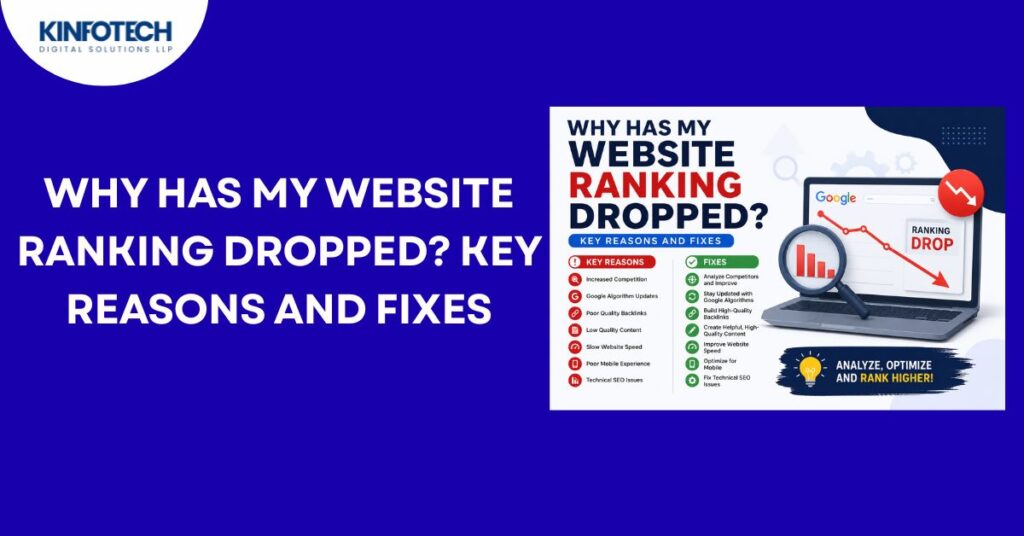
One morning you open Google Search Console and the traffic graph has taken a sudden nosedive. Or a client calls to say they can no longer find their business on the first page for the keyword that used to bring in most of their leads. That sinking feeling is something every website owner eventually experiences. Most ranking drops are explainable, diagnosable, and recoverable when you know where to look.
The challenge is that Google does not send you an email explaining what went wrong. Rankings change for dozens of different reasons, from deliberate algorithmic updates to technical problems on your own site that no one caught in time. Some drops happen overnight. Others happen gradually over weeks before anyone notices the pattern. Understanding which type of drop you are dealing with is the first step toward fixing it, and this guide walks you through exactly that. If you have found yourself asking, “Why has my website ranking dropped?”, you are not alone, and more importantly, you are asking exactly the right question.
Website Ranking Dropped: How to Know If It Is Really Happening and How Serious It Is

First, Confirm the Drop Is Real and Measure Its Scope Before You Panic
The first thing to do when you suspect a website ranking dropped situation is to confirm that what you are seeing is a real, measurable decline rather than a normal daily fluctuation. Organic rankings move constantly, sometimes by one or two positions, sometimes by several pages, without any underlying problem. A keyword that sat at position 5 last week, sitting at position 8 this week, is not a crisis. A keyword that was in position 5 last month and is now in position 40 this month is a different matter entirely.
Open Google Search Console and look at your organic search performance data over the past 90 days, comparing it to the same period the previous year. Look for sudden drops in clicks, impressions, or average position for specific pages or across the site as a whole. Cross-reference with Google Analytics to see whether the organic traffic drop matches what the rankings data suggests. If both tools show the same decline over the same timeframe, you have a real problem worth investigating.
Distinguish Between a Single Page Drop and a Sitewide Rankings Collapse
Not all website ranking drop situations affect the entire site equally. Sometimes a single page or a cluster of pages loses ranking while the rest of the site remains stable. Other times, every page on the site drops simultaneously. These two scenarios have very different causes and therefore require different investigations.
A single page drop is often caused by content becoming outdated, a competitor publishing significantly stronger content on the same topic, a technical issue specific to that URL, such as a broken canonical tag, or a manual action targeting specific content. A sitewide drop is more likely to be connected to a broad algorithm update, a site-level technical problem such as a crawlability issue, a significant loss of backlinks, or a manual penalty applied to the entire domain. Identify which pattern applies to your site before going any further.
Tools That Help You Track Exactly When the Drop Began
Pinpointing exactly when the ranking decline started is critical because it allows you to correlate the drop with specific events: Google algorithm updates, changes you made to the site, new content you published, or links you may have acquired or lost. Three tools are particularly useful for this: Google Search Console for ranking and impression data, Semrush or Ahrefs for historical keyword position tracking, and Google’s own algorithm update history page, which documents every confirmed core update by date.
If your traffic drop began on or within a few days of a known Google core update, the cause is almost certainly algorithmic. If it began immediately after a site migration, a CMS update, a new plugin installation, or a change to your robots.txt file, the cause is almost certainly technical. These two investigation paths lead in entirely different directions.
Google Ranking Dropped After a Core Update: What It Actually Means
What a Google Core Update Actually Does to Your Rankings and Why
A Google ranking drop tied to a core algorithm update is one of the most misunderstood events in the SEO world. When Google releases a broad core update, it is not penalising specific websites for doing something wrong. It is recalibrating how it evaluates quality, relevance, and expertise across the entire web. Sites that were previously ranking well may find themselves displaced by content that better satisfies Google’s updated understanding of what users actually need.
Google releases multiple broad core updates every year, and each one can shift rankings significantly for large numbers of websites. The August 2023 core update, for instance, caused measurable traffic declines for major content publishers across multiple sectors. The September 2024 core update had an outsized impact on affiliate review sites and thin informational content. If your drop lines up with one of these updates, the question is not “what did I do wrong” but “what does Google now expect that my content is not delivering?”
The E-E-A-T Framework Is the Lens Through Which Google Now Evaluates Content Quality
Since the Helpful Content system became part of Google’s core ranking infrastructure, the concept of E-E-A-T, which stands for Experience, Expertise, Authoritativeness, and Trustworthiness, has become central to how Google evaluates whether a piece of content deserves to rank. Sites that lost ranking after recent core updates consistently share one of several characteristics: content written by unnamed authors with no demonstrated expertise, pages that cover topics superficially without adding original insight, or websites in sensitive categories like health and finance where the stakes of bad information are high.
If your Google ranking dropped following a core update, ask yourself honestly whether your content demonstrates first-hand experience with the topic, whether it is written or reviewed by someone with genuine expertise in the field, and whether your website as a whole communicates the kind of authority that would make a first-time visitor trust what you are saying. If the answer to any of these is uncertain, that is likely the direction your recovery effort needs to go.
Why Core Update Recoveries Take Longer Than Most People Expect
One of the most frustrating aspects of recovering from a core update impact is the timeline. Unlike a technical fix that can produce visible results within days of implementation, content quality improvements tied to a core update are typically not recognised by Google until the next broad core update rolls out, which can be anywhere from one month to six months later. This does not mean the work is pointless. It means the work must be done well in advance of the next update, not reactively during the recovery window.
Technical Causes of SEO Ranking Drop That Are Hiding in Plain Sight
Site Speed, Core Web Vitals, and Why Technical Performance Now Directly Affects Rankings
A technical SEO ranking drop is often harder to spot than an algorithm-related one because the cause is not visible on the surface of the page. Your content looks fine. Your design has not changed. But something under the hood is sending negative signals to Google’s crawlers. Site speed is one of the most common technical culprits. Since Google made Core Web Vitals an official ranking signal in 2021, page loading performance, interactivity, and visual stability have all become direct contributors to ranking position.
A page that previously loaded in 2.1 seconds but now loads in 4.7 seconds because of a new plugin, a third-party script, or unoptimised images added during a site update will gradually lose ranking as Google’s quality signal recalibrates around that changed performance. The frustrating part is that this kind of degradation rarely produces a sudden visible drop. It erodes rankings slowly over weeks, making it easy to miss until the decline is already significant.
Crawlability and Indexation Errors That Silently Remove Pages From Google’s Index
Some of the most impactful causes of a sudden SEO ranking drop are also some of the simplest to produce accidentally. A robots.txt change that blocks Googlebot from crawling key sections of your site. A noindex tag was added during development that was never removed when the site went live. A canonical tag pointing to the wrong URL. An XML sitemap that has not been updated since a site migration six months ago and still references hundreds of URLs that no longer exist.
Each of these issues can cause Google to stop crawling, indexing, or ranking affected pages almost immediately. Google Search Console’s Coverage report is the first place to check. If you see a sudden increase in “Excluded” URLs or pages moving from “Valid” to “Crawled, not currently indexed,” these are strong indicators that a technical change has affected how Google is processing your site. In most cases, identifying and reverting the specific change that introduced the problem is sufficient to begin recovering rankings within a few weeks.
The Impact of Lost Backlinks on Competitive Keywords and Domain Authority
Backlinks remain one of the most significant ranking signals for competitive keywords. When a high-authority website that linked to your content is taken down, restructures its site, or removes the specific page containing your link, you lose the authority transfer that link was providing. If enough of this happens over a short period, particularly on your most competitive terms, a ranking drop is the predictable result.
This is worth monitoring regularly using tools like Ahrefs or Semrush’s backlink tracking features. Set up alerts for significant lost links so you can respond quickly, whether by reaching out to the referring site to request reinstatement or by developing new content that can attract replacement links from comparable authority sources.
Website Ranking Is Going Down Slowly? This Is What a Gradual Decline Signals

Content Decay Is the Quiet Killer of Organic Traffic That Most Sites Ignore Until It Is Too Late
Not every website ranking going down situation involves a sudden, dramatic drop. Sometimes the decline is slow, steady, and almost invisible month to month until you compare this year to last year and find a 30% or 40% reduction in organic traffic that nobody noticed happening. This pattern is usually caused by content decay, which is the natural process by which web content becomes less relevant and less competitive over time without being updated.
A blog post that ranked in position 3 for an informational keyword three years ago may have been the best available answer at that time. Since then, five competitors have published more detailed, more recently updated versions of the same information. Google’s continuous re-evaluation of which content best serves search intent has gradually shifted the ranking toward those fresher, more thorough alternatives. The original post has not changed. But the competitive landscape around it has changed significantly.
Keyword Cannibalisation Quietly Splits Authority Between Pages Competing for the Same Term
One cause of a gradual website ranking is going down situation that consistently surprises website owners is keyword cannibalisation. This happens when multiple pages on your site are targeting the same or very similar keywords, causing Google to split its ranking authority between them rather than concentrating it on a single strong page. Instead of one page ranking in position 5 for a term, you might have three pages each ranking between positions 25 and 45, none of which generates meaningful clicks.
This is a content architecture problem. It often develops gradually as a site grows and new content is added without a clear map of which page should own which topic. Tools like Semrush’s Keyword Cannibalisation report or a manual audit of your top keyword targets against your page inventory can identify where this is happening. The resolution usually involves consolidating competing pages, establishing clear canonical signals, or restructuring internal linking to concentrate authority on the preferred ranking URL.
Changes in Search Intent That Shift What Type of Content Google Wants to Rank
Sometimes the reason a page loses ranking has nothing to do with what you did or did not do. Google’s understanding of what users actually want when they search a particular query, known as search intent, evolves over time, and the type of content that best serves that intent changes with it. A keyword that was best served by a detailed long-form guide two years ago may now be best served by a comparison page, a listicle, or even a video embed, because Google has learned from user behaviour that searchers for that term prefer a different format.
Checking the current first-page results for your target keywords and comparing them to what ranked when your page was performing well reveals these shifts clearly. If the top results have all changed format since your page was ranking, you may need to restructure your content to match the updated intent signal.
Google Ranking Issues You Must Rule Out Before Assuming the Worst

Manual Actions and Spam Penalties Are Rare but They Are the Most Severe Google Ranking Issues
The most serious Google ranking issues are manual actions, which are penalties applied by a human reviewer at Google to websites found to be violating the search quality guidelines. Manual actions are different from algorithmic adjustments because they are deliberate and targeted, and they require explicit remediation and a reconsideration request through Google Search Console to lift.
The good news is that manual actions are also the easiest to identify. Google Search Console’s Manual Actions report will explicitly notify you if a manual action has been applied to your site, what the specific violation is, and which pages or the entire site is affected. Common reasons for manual actions include unnatural link profiles, thin or copied content, cloaking, structured data violations, and user-generated spam. If this report shows no issues, a manual action is not the cause of your drop.
Negative SEO, Competitor Activity, and External Factors That Hurt Rankings Without Warning
Sometimes a Google ranking issues situation is driven not by what you did but by what a competitor has done, either to their own site to outperform you or, in rare cases, deliberately to your site to harm you. Negative SEO, which involves pointing large volumes of low-quality links at a competitor’s site to trigger a spam signal, is something Google has become better at detecting and discounting. But it is not completely immune to it.
Check your backlink profile in Ahrefs or Google Search Console for any sudden spikes in low-quality links pointing to your site from irrelevant, foreign-language, or spam-associated domains. If you find suspicious patterns, the disavow tool in Google Search Console allows you to instruct Google to ignore specific links when evaluating your site. Use it carefully and only after verifying the links are genuinely harmful.
Tracking Code Issues, Redirect Chains, and Other Invisible Problems That Confuse Google
A final category of Google ranking issues worth checking is the structural and technical layer that sits between your content and Google’s crawler. Broken redirect chains, where multiple redirects fire sequentially before reaching the destination URL, pass less authority and load more slowly than a direct redirect. Incorrect hreflang implementation for multilingual sites can cause Google to index the wrong language version. Duplicate content across HTTP and HTTPS versions of your site can dilute authority if the canonical is not correctly configured.
None of these issues sounds dramatic, but any one of them, left uncorrected, applies a steady drag on rankings that compounds over time. A comprehensive technical SEO audit is the only reliable way to surface all of these simultaneously and get a clear picture of how many small technical problems might be collectively producing a large ranking impact.
| Further Reading: The Decline of Navigational Keywords in the AI Era |
Conclusion
There is almost always an answer to “Why has my website ranking dropped?” The answer might be uncomfortable because it requires acknowledging that your content needs to improve, or because it involves finding and fixing a technical problem you did not know existed. But the diagnosis is almost always there if you look in the right places and with the right tools.
Ranking drops are recoverable in the vast majority of cases. The difference between a business that recovers its rankings within two to three months and one that stays down for six months or more is usually the speed and accuracy of the initial diagnosis, and the quality of the recovery plan that follows it.
If you have worked through the diagnostic process in this guide and still cannot identify what is driving your drop, it is worth bringing in a specialist who can look at your specific situation with fresh eyes and deeper analytical tools. The team at Kinfotech Digital Solutions regularly helps businesses identify the exact cause of ranking drops and develop structured recovery plans that address the root issue rather than the symptoms. Starting with a proper diagnosis is always the right first step.
Frequently Asked Questions (FAQs)
1. Why has my website ranking dropped suddenly overnight?
A sudden overnight ranking drop is most commonly caused by a Google algorithm update, a technical change on your site such as a robots.txt modification or incorrectly applied noindex tag, a significant loss of high-authority backlinks, or in rare cases a manual action penalty that can be confirmed in Google Search Console’s Manual Actions report.
2. How long does it take to recover from a website ranking drop?
Recovery timelines vary significantly by cause: technical fixes such as crawlability errors often produce visible recovery within two to four weeks of correction, while content quality improvements tied to a Google core update may not be recognised until the next broad core update, which can be anywhere from one to six months away.
3. Will my Google ranking dropped situation recover on its own without changes?
Ranking drops caused by algorithm updates affecting content quality rarely self-resolve without deliberate improvements, as Google’s recalibration reflects real gaps in your content relative to competitors; however, drops caused by temporary technical errors on Google’s end, which are less common, can sometimes recover automatically within days.
4. How do I know if my SEO ranking drop is from a Google update or a technical problem?
Check the timing of your drop against Google’s official algorithm update history: if the drop began within two to three days of a confirmed core update, the cause is likely algorithmic; if it began coinciding with a site migration, CMS update, plugin change, or configuration edit, the cause is almost certainly technical and should be investigated through Google Search Console’s Coverage and Performance reports.
5. What is the first tool I should check when my website ranking is going down?
Google Search Console is always the correct starting point because it provides the most authoritative data on how Google specifically sees your site, including ranking position changes over time, coverage and indexation status, manual actions, and core web vitals performance data that no third-party tool can replicate with the same accuracy.