

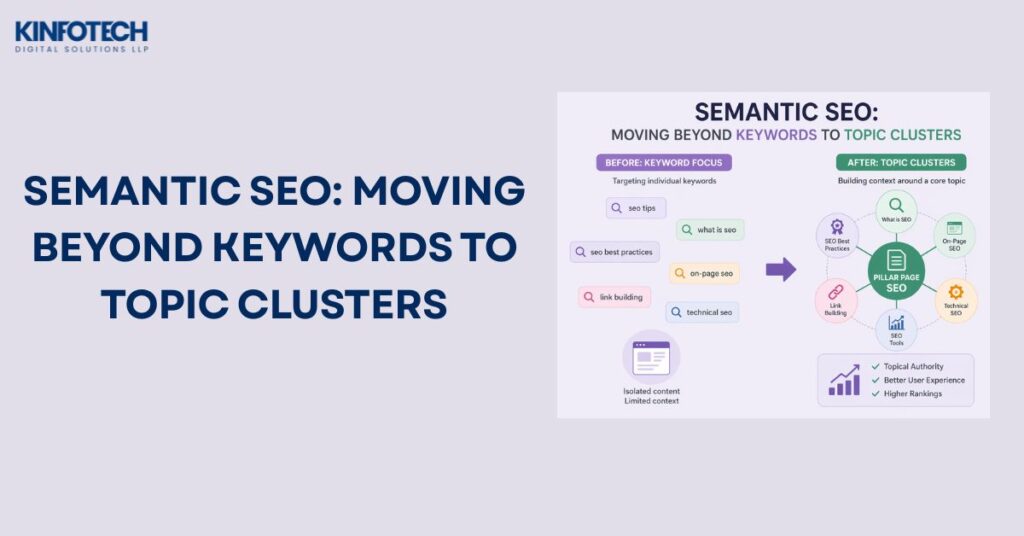
If you have been trying to rank on Google by stuffing keywords into your pages and wondering why it is not working, you are not alone. Search engines have evolved. Today, Google cares far more about meaning than repetition. This shift is at the heart of what a strong semantic SEO strategy is all about.
In this guide, we will explain semantic SEO in plain language, show you why it works better than old-school keyword tactics, and walk you through a practical step-by-step approach to building topic clusters that drive real rankings and long-term authority.
What Is Semantic SEO? A Simple Explanation
Semantic SEO is a way of creating and organizing content so that Google can understand the full context and meaning behind what you write, not just the specific words you use.
Think of it this way. When you search “best food for a puppy,” Google does not just look for pages with those exact words. It understands that you are asking about dog nutrition, puppy feeding schedules, and healthy ingredients. That understanding is semantic search at work.
A solid semantic SEO strategy means you create content around topics, not just individual keywords. You answer related questions, cover supporting ideas, and connect your pages together so Google sees your website as a trusted authority on a subject.
Want to learn how SEO can grow your business online? Read more about our SEO Services.
Traditional SEO vs. Semantic SEO: What Has Changed?
Many small business owners are still using SEO tactics from five or ten years ago. Understanding the difference between traditional and semantic search optimization is the first step to getting better results.
| Traditional SEO | Semantic SEO | Why It Matters |
| Focuses on exact keywords | Focuses on topics and meaning | Google now reads context, not just words |
| One page per keyword | Pillar pages and cluster content | Clusters signal broader authority |
| Keyword density is prioritized | User intent is prioritized | Google rewards pages that match intent |
| Pages work independently | Pages are interlinked as a cluster | Internal links pass authority across pages |
| Short, keyword-stuffed content | In-depth, topic-covering content | Comprehensive content ranks longer |
The shift is clear. Modern SEO rewards websites that prove topical depth, not those that simply repeat the same phrase over and over.
Curious how AI is changing SEO? Explore our latest insights. Check out our blog on AI SEO Agents.
Upgrade Your SEO Approach — Book a Free Audit
What Are Topic Clusters and Pillar Pages?

Topic clusters are groups of related web pages that cover a broad subject in depth. The structure is simple and powerful: one pillar page covers the main topic broadly, while several cluster pages go deep on specific subtopics and link back to the pillar.
Topic clusters SEO is one of the most effective ways to signal authority to Google. When your website has ten pages all covering different angles of the same subject, and they all link to each other, Google sees you as a genuine expert on that topic.
The Three Parts of a Topic Cluster
| Component | What It Is | Example |
| Pillar Page | A long, comprehensive page covering a broad topic | “Complete Guide to Small Business SEO” |
| Cluster Pages | Shorter pages that go deep on one specific subtopic each | “How to Do Keyword Research” or “What Is Local SEO” |
| Internal Links | Links connecting cluster pages back to the pillar page | Each cluster article links to the main SEO guide |
This connected structure is what makes SEO content clusters so powerful. Google crawls the links, understands the relationship between pages, and ranks your pillar page higher because it sees the full depth of your topical coverage.
Learn how our SEO strategies are built for small business growth. Read more about our SEO services here.
How Google Understands Search Intent?
Search intent is the reason behind someone’s search. When someone types a query into Google, they are not just looking for a matching phrase. They have a goal. Google’s job is to figure out that goal and return the most useful result. Semantic search optimization is built on understanding four types of search intent:
| Intent Type | What the User Wants | Example Search |
| Informational | To learn or understand something | “What is SEO?” |
| Navigational | To find a specific website or brand | “Kinfotech SEO services” |
| Commercial | To compare options before buying | “Best SEO agency for small business” |
When you align your content with the right intent, Google is far more likely to rank it highly. A page written to answer an informational question should not read like a sales pitch. A transactional page should make it easy to take the next step. Understanding intent is at the core of every effective content cluster strategy SEO plan. It shapes what you write, how you write it, and which pages you connect together.
See how our content and SEO work together to attract the right audience. Explore our full range of digital services.
Benefits of a Semantic SEO Strategy for Small Businesses
For small business owners, building a semantic search strategy is one of the smartest investments you can make online. Here is why:
| Benefit | What It Means for Your Business |
| Better Rankings | Google rewards topical authority, so covering a subject in depth pushes your pages higher. |
| More Organic Traffic | Cluster pages rank for many different search terms, multiplying your visibility. |
| Stronger Authority | When Google sees your site as an expert on a topic, it trusts your content more over time. |
| Lower Bounce Rate | Well-connected content keeps visitors on your site longer, which signals quality to Google. |
| Long-Term Growth | Semantic content builds momentum over time and keeps delivering traffic without extra ad spend. |
| Brand Credibility | Covering your subject thoroughly makes visitors trust your brand before they ever contact you. |
At Kinfotech Digital Solutions, we have helped over 600 small business clients build content strategies that drive sustainable growth. Our team understands what it takes to compete in crowded markets, whether you are a local service provider, an eCommerce brand, or a professional services firm.
Find out how we have helped small businesses grow their online presence since 2016. Read more about our SEO services for small businesses.
Step-by-Step Process to Create Topic Clusters
Building topic clusters SEO does not need to be complicated. Follow these steps, and you will have a working cluster strategy in place:
- Step 1: Choose Your Core Topic. Pick a broad subject that is central to your business. For example, a small business owner in marketing might choose “SEO for small businesses” as their core topic.
- Step 2: Write Your Pillar Page. Create one long, comprehensive page that covers the core topic from every angle. This does not go too deep on any single point it acts as a guide that links out to cluster pages.
- Step 3: Identify Cluster Subtopics. Brainstorm 8 to 12 questions or subtopics related to your core subject. These become the focus of your cluster content pages.
- Step 4: Create Cluster Content. Write one focused page for each subtopic. Each page should answer one specific question in depth and link back to your pillar page.
- Step 5: Map Search Intent. Before writing, confirm whether each subtopic is informational, commercial, or transactional. Align your content tone to match what the user actually wants.
- Step 6: Add Internal Links. Link each cluster page to your pillar page and link the pillar page back to each cluster. This creates the connected structure that Google rewards.
- Step 7: Optimize with LSI and Related Terms. Include semantically related phrases naturally throughout your content. This reinforces topical depth without keyword stuffing.
- Step 8: Track and Expand. Use Google Search Console and analytics to see which cluster pages gain traction. Add more cluster pages over time to deepen your topical authority.
Our SEO team can build and manage your entire topic cluster strategy. Check out our SEO service packages.
Let Us Build Your Cluster Content Plan — Free Strategy Call
A Real Example of a Topic Cluster
Let us say you run a small digital marketing agency. Your topic modeling for ranking approach might look like this:
| Page Type | Page Topic | Search Intent |
| Pillar Page | Complete Guide to SEO for Small Businesses | Informational |
| Cluster Page 1 | How to Do Keyword Research for a Small Business | Informational |
| Cluster Page 2 | What Is Local SEO and Why Does It Matter? | Informational |
| Cluster Page 3 | On-Page SEO Checklist for Beginners | Informational |
| Cluster Page 4 | How Long Does SEO Take to Show Results? | Commercial |
| Cluster Page 5 | Best SEO Tools for Small Businesses in 2025 | Commercial |
| Cluster Page 6 | Hire an Affordable SEO Agency for My Business | Transactional |
Every cluster page links back to the pillar guide. Every visitor who reads one cluster page is invited deeper into the website. Google crawls the internal links and builds a clear picture of your topical expertise. This is what an effective content cluster strategy SEO looks like in practice. It is not complicated. It is consistent, structured, and deeply valuable for your audience.
Read about how Googlebot actually crawls and understands your content structure. Read more about how Googlebot accesses your HTML.
Conclusion:
Build Authority, Not Just Rankings
Keyword stuffing is a relic of the past. Today, winning on Google means proving that your website is the most useful, most comprehensive, and most trustworthy resource on a subject. That is exactly what a well-built semantic SEO strategy delivers.
From creating your first pillar page to building out a full cluster of supporting content, every step moves your website closer to the kind of authority that drives consistent, long-term organic traffic. And for small businesses, that traffic translates directly into leads, customers, and growth.
At Kinfotech Digital Solutions, we specialize in helping small business owners build the kind of online presence that compounds over time. We handle strategy, content structure, internal linking, and optimization, so you can focus on running your business while we grow your rankings.
See how we have helped over 600 businesses grow with data-driven SEO. Explore our SEO services for small businesses.
Frequently Asked Questions
Q1: What is the difference between semantic SEO and regular SEO?
Regular SEO focuses on matching exact keywords, while semantic SEO focuses on covering topics in depth so Google understands the full meaning of your content.
Q2: How many cluster pages do I need to start?
Starting with 5 to 8 cluster pages around one pillar is enough to build initial topical authority and begin seeing results.
Q3: Does semantic SEO work for small businesses?
Yes, it is especially powerful for small businesses because it builds long-term organic traffic without depending on paid ads.
Q4: How long does it take to see results from topic clusters?
Most businesses begin to see ranking improvements within 3 to 6 months as Google indexes and processes the cluster structure.
Q5: Can Kinfotech Digital Solutions build topic clusters for my business?
Yes, Kinfotech offers full topic cluster planning, content creation, and internal link strategy as part of its SEO services for small businesses.
Learn more about performance-based and affordable SEO options for small businesses. Read our guide on Pay for Performance SEO.
| Do not let another lead fall through the cracks. Contact us today and get started with a free CRM consultation. Get Your Free CRM Audit | Book a Demo | Talk to Our Experts |