


If your online store is not ranking on Google, the problem might not be your content or your products. It could be something deeper. A technical SEO audit for ecommerce websites is the process of examining your website’s infrastructure to identify issues that prevent search engines from properly crawling, indexing, and ranking your pages.
Think of it as a full health check for your website. Just like a doctor reviews your vitals before diagnosing a problem, a technical audit uncovers the hidden issues quietly hurting your search visibility and customer experience.
E-commerce sites have unique challenges. They often contain thousands of product pages, dynamic filters, and category structures that make them especially vulnerable to technical errors. That is why understanding and fixing these issues through a structured audit is one of the smartest investments an online store can make.
What Is a Technical SEO Audit?
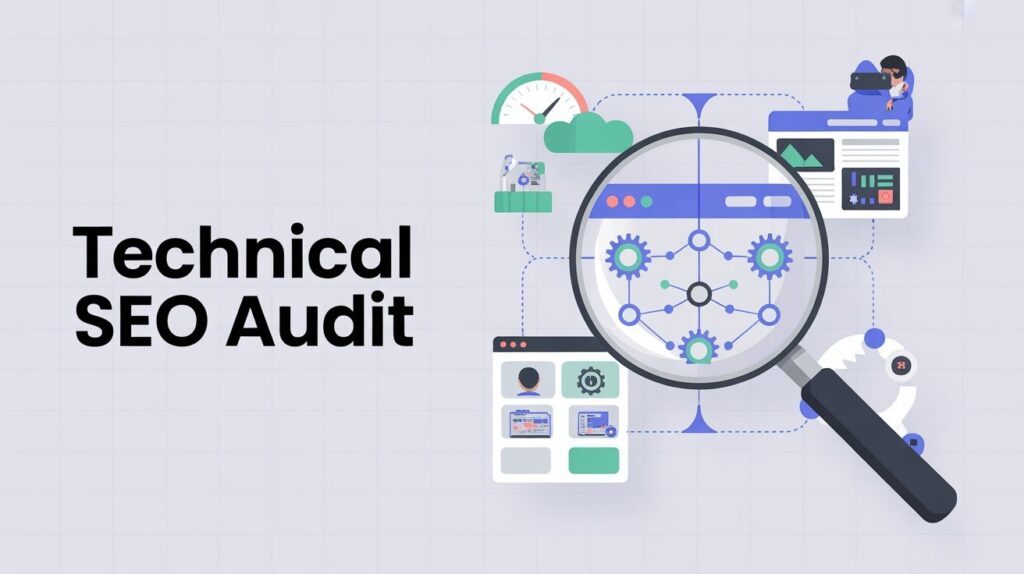
A technical SEO audit is a detailed review of your website from a search engine’s perspective. It checks how well your site can be accessed, read, and ranked by Google and other search engines.
The audit covers areas like site speed, URL structure, duplicate content, mobile usability, structured data, internal linking, and crawl errors. These are all backend factors that directly affect how well your website performs in search results.
Unlike content audits that focus on what you say, a technical audit focuses on how your website works. Both are important, but technical issues must be fixed first because even the best content will not rank on a broken or slow website.
| SEO Type | What It Covers |
| Content SEO | Focuses on keywords, blog posts, and copy quality |
| Technical SEO | Focuses on site speed, crawlability, and structure |
| On-Page SEO | Focuses on title tags, headers, and metadata |
| Technical Audit | Reviews all backend factors affecting search performance |
Related Read: Why Your Business Needs SEO Services to Grow Online in 2026
Explore Our Content Optimization Services
Why Technical SEO Is Critical for E-commerce Sites
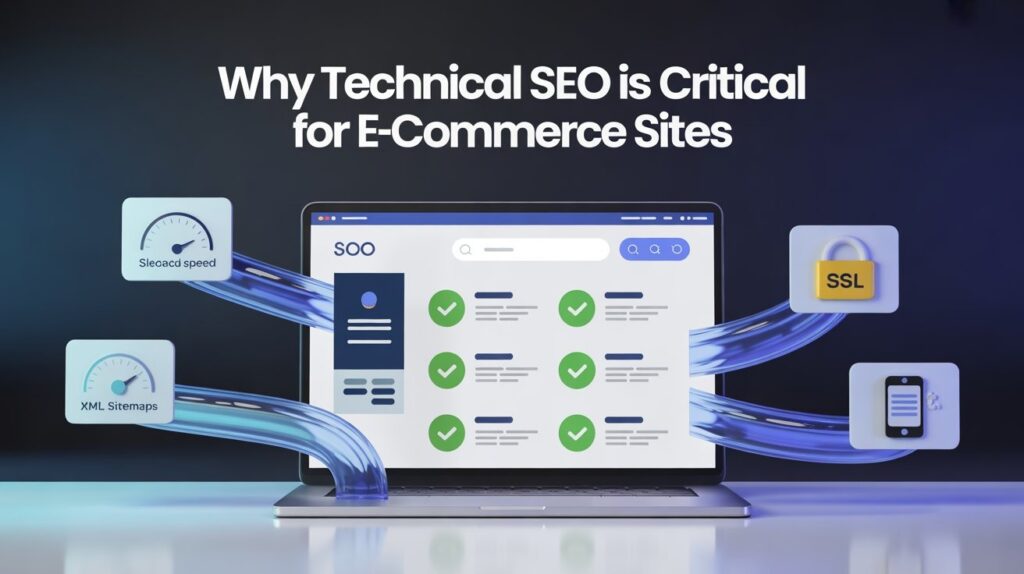
E-commerce websites are complex. A single store might have hundreds of product pages, dozens of filters, and multiple URL variations for the same item. Without a proper technical foundation, search engines struggle to understand and rank your content.
Here is why technical SEO matters specifically for online stores:
• Crawl budget matters more: Search engines allocate a limited number of page crawls per visit. Technical errors waste this budget on low-value pages, leaving important product and category pages unindexed.
• Duplicate content is common: Product filters and sorting options often create duplicate URLs. This confuses Google and can lead to ranking drops.
• Site speed affects conversions: A one-second delay in load time can reduce conversions by up to 7 percent. Slow pages hurt both rankings and revenue.
• Mobile traffic dominates: Most shoppers browse on phones. Google uses mobile-first indexing, so poor mobile performance directly hurts your rankings.
• Structured data drives rich results: Product schema helps Google display prices, ratings, and availability in search results, increasing click-through rates.
Related Read: What Are AI SEO Agents? Features and Benefits Explained
Get a Free SEO Consultation Today
Common Technical Issues Found in E-commerce Websites
During an ecommerce website SEO audit, several recurring issues appear across stores of all sizes. Identifying and fixing them is the core goal of any audit process.
1. Site Speed Problems
Slow-loading pages are one of the biggest conversion killers in e-commerce. Pages with heavy images, unoptimized code, or no caching lose both rankings and customers.
• Uncompressed images on product pages slow load time significantly
• Too many third-party scripts from tracking tools and pop-ups delay rendering
• No content delivery network (CDN) means slow speeds for international users
2. Crawl Errors and Indexing Issues
Crawl errors occur when search engines cannot access or understand your pages. These are especially damaging for category and product pages that need to rank.
• 404 errors on deleted or moved product pages
• Blocked pages in robots.txt that should be indexed
• Orphaned pages with no internal links pointing to them
3. Broken Links
Broken links frustrate users and signal poor site maintenance to search engines. They are common in stores that frequently update their product catalog.
• Internal links pointing to discontinued product pages
• Outdated category page links after site restructuring
• External links to supplier or review pages that no longer exist
4. Missing or Incorrect Structured Data
Structured data (schema markup) helps Google understand your content better. Without it, your products miss out on rich results like star ratings, prices, and availability.
• Product schema missing on individual product pages
• Incorrect breadcrumb markup on category pages
• No review schema on pages with customer testimonials
| Issue | Tool to Detect | Fix Strategy |
| Site Speed | Use Google PageSpeed Insights | Compress images, enable caching |
| Crawl Errors | Google Search Console | Fix 404s, update sitemaps |
| Broken Links | Screaming Frog / Ahrefs | Redirect or remove broken links |
| Structured Data | Google Rich Results Test | Add or fix schema markup |
| Duplicate Content | Sitebulb / SEMrush | Canonical tags, noindex filters |
Related Read: How Googlebot Accesses Your HTML File
Optimize Your Content Strategy Now
How Technical Audits Improve Rankings, Traffic, and Conversions
Fixing technical issues is not just about ticking SEO boxes. It directly improves the experience for your customers and the performance of your business.
Better Rankings: When crawl errors are fixed and site speed improves, Google can access and rank your pages more effectively. Category pages and product pages start appearing for more relevant search queries.
More Organic Traffic: Properly structured pages with correct indexing signals attract more impressions in Google Search. Better metadata canonical tags, and structured data lead to higher click-through rates.
Higher Conversions: A fast, mobile-friendly, and error-free website builds trust with shoppers. Customers who face fewer friction points are more likely to complete a purchase.
| Technical Fix | Business Impact |
| Fixing crawl errors | More pages indexed and ranking |
| Improving page speed | Lower bounce rate, higher engagement |
| Adding structured data | Rich results with higher click-through rates |
| Fixing broken links | Better user flow and trust signals |
| Mobile optimization | Improved rankings on mobile searches |
Related Read: Removing URLs in XML Sitemap Won’t Hurt Your Google Rankings
Start Your Ecommerce Content Optimization
Step-by-Step Approach to Conducting a Technical SEO Audit
Whether you use ecommerce SEO audit services USA or run the audit yourself, a structured process ensures nothing is missed. Here is a practical step-by-step guide:
1. Step 1: Crawl the Website using tools like Screaming Frog, Sitebulb, or Ahrefs to map all URLs and identify errors, redirects, and duplicate content.
2. Step 2: Check Google Search Console for crawl errors, manual actions, coverage issues, and Core Web Vitals scores specific to your e-commerce pages.
3. Step 3: Audit Site Speed using Google PageSpeed Insights and GTMetrix. Focus especially on product pages and landing pages where conversions happen.
4. Step 4: Review URL Structure to ensure clean, keyword-rich URLs for product and category pages. Avoid long parameter strings and dynamic URLs where possible.
5. Step 5: Check Indexability by reviewing your robots.txt file, XML sitemap, and canonical tags. Make sure important pages are indexed and thin or duplicate pages are properly handled.
6. Step 6: Validate Structured Data using the Google Rich Results Test. Confirm that product schema, breadcrumb schema, and review schema are correctly implemented.
7. Step 7: Test Mobile Usability using Google Mobile-Friendly Test and manually browsing on different screen sizes. Check button sizes, font readability, and checkout flow.
8. Step 8: Analyze Internal Linking to ensure all important product and category pages are reachable within three clicks from the homepage. Remove or redirect orphaned pages.
9. Step 9: Fix Broken Links by running a broken link scan and either redirecting or removing all internal and external 404 links.
10. Step 10: Create an Action Plan by prioritizing fixes based on impact. Start with crawl errors and speed issues, then move on to schema and mobile optimization.
Related Read: Technical SEO vs Programmatic SEO: What’s the Difference
Request a Full Technical SEO Audit
Real-World Examples for E-commerce
Understanding how technical SEO works in practice makes it easier to apply. Here are two common real-world scenarios:
Product Pages
A clothing retailer had hundreds of product pages with duplicate titles because size variations (S, M, L, XL) generated separate URLs with nearly identical content. An ecommerce website SEO audit identified this issue immediately.
The fix involved setting canonical tags so that the main product URL was treated as the authoritative version. Product schema was also added with price, availability, and review data. As a result, the store saw a 34 percent increase in organic impressions within 60 days.
Category Pages
A home goods store noticed that its category pages were being filtered out of Google’s index. The audit revealed that filter parameters like ?sort=price and ?color=red were generating thousands of near-duplicate URLs that were consuming the crawl budget.
The solution was to use parameter handling in Google Search Console and add noindex tags to filtered pages. The main category pages regained their ranking positions within six weeks, and organic traffic increased by 28 percent.
| Page Type | Real-World Technical Fix Applied |
| Product Pages | Added canonical tags and product schema to size variant URLs |
| Category Pages | Used noindex on filter URLs to fix crawl budget waste |
| Checkout Pages | Removed render-blocking scripts to improve load speed |
| Blog Pages | Fixed broken internal links pointing to discontinued products |
Benefits of Technical SEO Audits for E-commerce Businesses
The benefits of a well-executed technical SEO audit for ecommerce websites extend beyond search rankings. They touch every part of the customer journey.
Improved User Experience (UX)
• Faster pages reduce frustration and bounce rates
• Clear URL structures make navigation intuitive
• Error-free browsing builds trust with new visitors
Faster Checkout and Better Conversions
• Removing render-blocking scripts speeds up the checkout flow
• Lightweight pages perform better on slow mobile connections
• Structured data with pricing and availability reduces pre-purchase doubt
Mobile Optimization
• Google’s mobile-first indexing rewards stores with responsive, fast mobile pages
• Mobile-friendly checkout reduces cart abandonment
• Correct viewport settings ensure products display properly on all devices
Long-Term SEO Health
• Regular audits prevent small issues from becoming major ranking problems
• Clean technical foundations support future content and link building efforts
• Audit reports provide data-driven insights for ongoing SEO strategy
Related Read: Affordable Web Design and Development Services for Small Businesses
Boost Your Ecommerce Content and UX Today
SEO Audit for Shopify and Other E-commerce Platforms
A SEO audit for Shopify follows the same core principles but includes platform-specific considerations unique to Shopify’s architecture.
Shopify automatically generates canonical tags and XML sitemaps, which is helpful. However, it also creates duplicate URLs for collection pages and product pages that appear under multiple collections. This is a common issue that audits catch and resolve.
For WooCommerce, Magento, and BigCommerce stores, the audit process focuses on plugin conflicts, database-driven URL structures, and server response times. Each platform has its own strengths and vulnerabilities that an experienced team knows how to handle.
| Platform | Common Technical Issues | Priority Fix Areas |
| Shopify | Duplicate collection URLs, app script bloat, image optimization | |
| WooCommerce | Plugin conflicts, slow database queries, and permalink structure | |
| Magento | Layered navigation duplicates, server-side rendering speed | |
| BigCommerce | Faceted search URL handling, canonical tag management |
Related Read: Pay for Performance SEO: Why It Fails and What Works Instead
Get Platform-Specific SEO Help
Ready to Strengthen Your E-commerce SEO Foundation?
If your online store is not reaching its full potential on Google, it is time to take action. Our team at Kinfotech Solutions specializes in ecommerce SEO audit services USA and delivers clear, actionable audit reports that show you exactly what needs to be fixed and why.
We have helped e-commerce businesses across the US, India, and beyond fix critical technical issues and achieve measurable growth in traffic and revenue.
Our services include:
• Ecommerce Technical SEO Services: Full website audits covering speed, structure, indexation, and schema
• Ecommerce SEO Agency USA: Ongoing SEO management and monthly technical health monitoring
• SEO Audit for Shopify: Platform-specific audits for Shopify stores with detailed fix recommendations
• Ecommerce SEO Strategy: Data-driven content and technical plans aligned with your business goals
Book a Free Ecommerce SEO Consultation
Get Your Free Website Audit Report
Frequently Asked Questions (FAQ)
1. What is a technical SEO audit for ecommerce websites?
A technical SEO audit for ecommerce websites is a structured review of your site’s backend health, including speed, crawlability, indexing, mobile usability, and structured data to identify and fix issues affecting your Google rankings.
2. How often should I run an ecommerce website SEO audit?
It is recommended to run a full ecommerce website SEO audit at least once every quarter, with monthly monitoring of crawl errors, speed, and indexing status for active stores with frequent product updates.
3. What tools are used in ecommerce technical SEO services?
Common tools used in ecommerce technical SEO services include Screaming Frog, Google Search Console, Ahrefs, Semrush, GTMetrix, PageSpeed Insights, and Google Rich Results Test.
4. Does an SEO audit for Shopify differ from other platforms?
Yes, an SEO audit for Shopify includes platform-specific checks like duplicate collection URLs, app script bloat, and Shopify theme structure, in addition to standard technical checks like speed and structured data.
5. How do ecommerce SEO audit services USA help international stores?
Ecommerce SEO audit services USA help international stores by identifying region-specific indexing issues, hreflang implementation, CDN performance gaps, and localized structured data that affect search visibility across different countries.
Summary and Business Impact
A strong technical foundation is what separates e-commerce stores that grow from those that stagnate. Technical errors silently drain your visibility, waste your crawl budget, and push customers away before they ever see your products.
By investing in a regular ecommerce technical SEO services strategy, you ensure that every product page, category page, and landing page has the best possible chance of ranking and converting.
The business impact is real and measurable. Faster sites rank higher. Error-free pages get indexed. Structured data attracts more clicks. Mobile-optimized experiences reduce cart abandonment. Each of these improvements compounds over time, building a sustainable SEO growth engine for your store.
| Technical Improvement | Business Impact |
| Faster site speed | Higher rankings + lower bounce rate |
| Fixed crawl errors | More pages indexed and visible |
| Structured data added | Rich results with higher CTR |
| Mobile optimization | Better experience for mobile shoppers |
| Duplicate content fixed | Stronger ranking signals per page |
| Internal linking improved | More authority is distributed across product pages |
Start with an audit, fix the foundation, and build from there. That is the strategic value of technical SEO for e-commerce, and it is a competitive advantage your store cannot afford to ignore.
| Do not let another lead fall through the cracks.Contact Kinfotech Digital Solutions today and get started with a free CRM consultation.Get Your Free CRM Audit | Book a Demo | Talk to Our Expertswww.kinfotechsolutions.com |